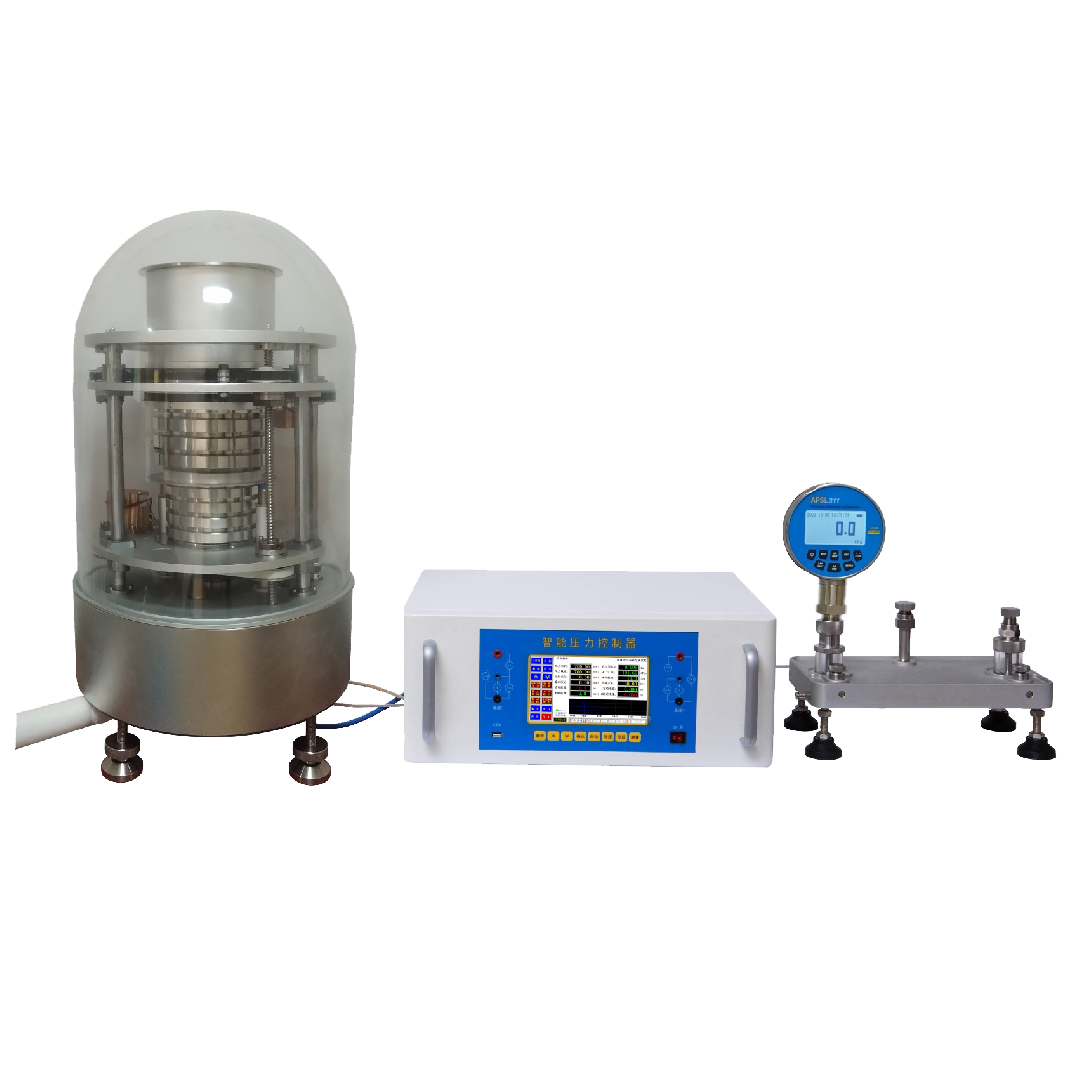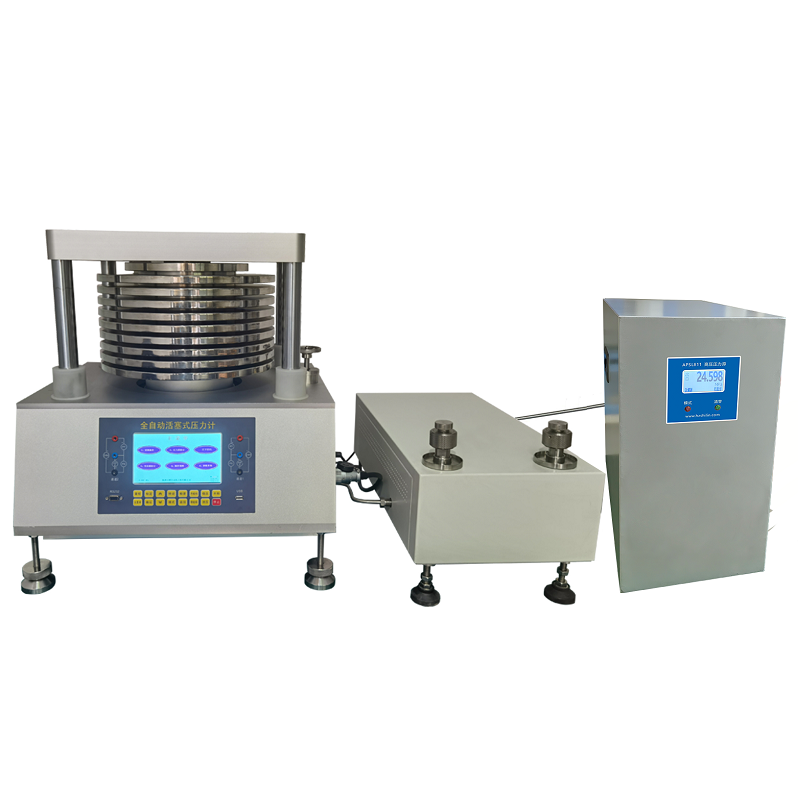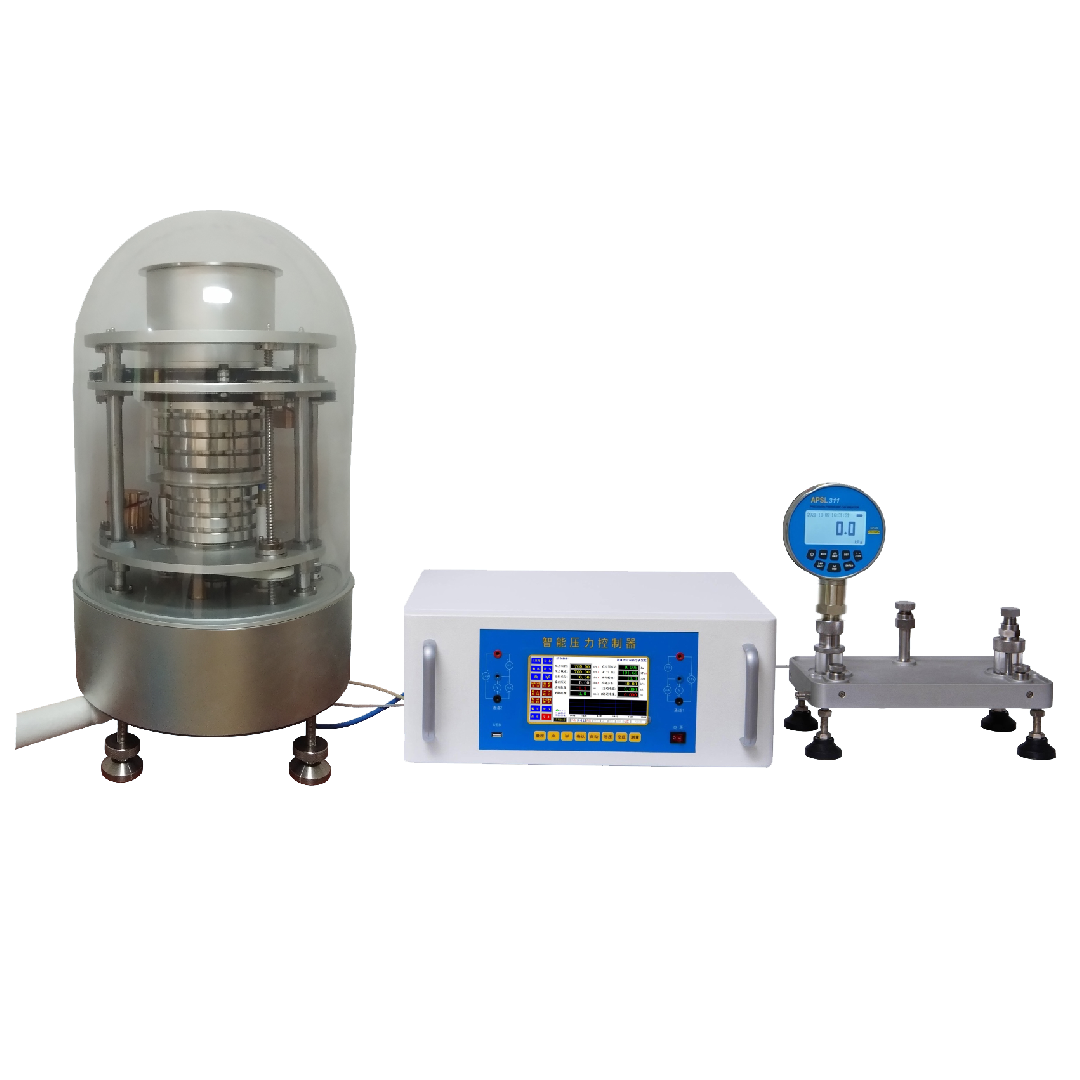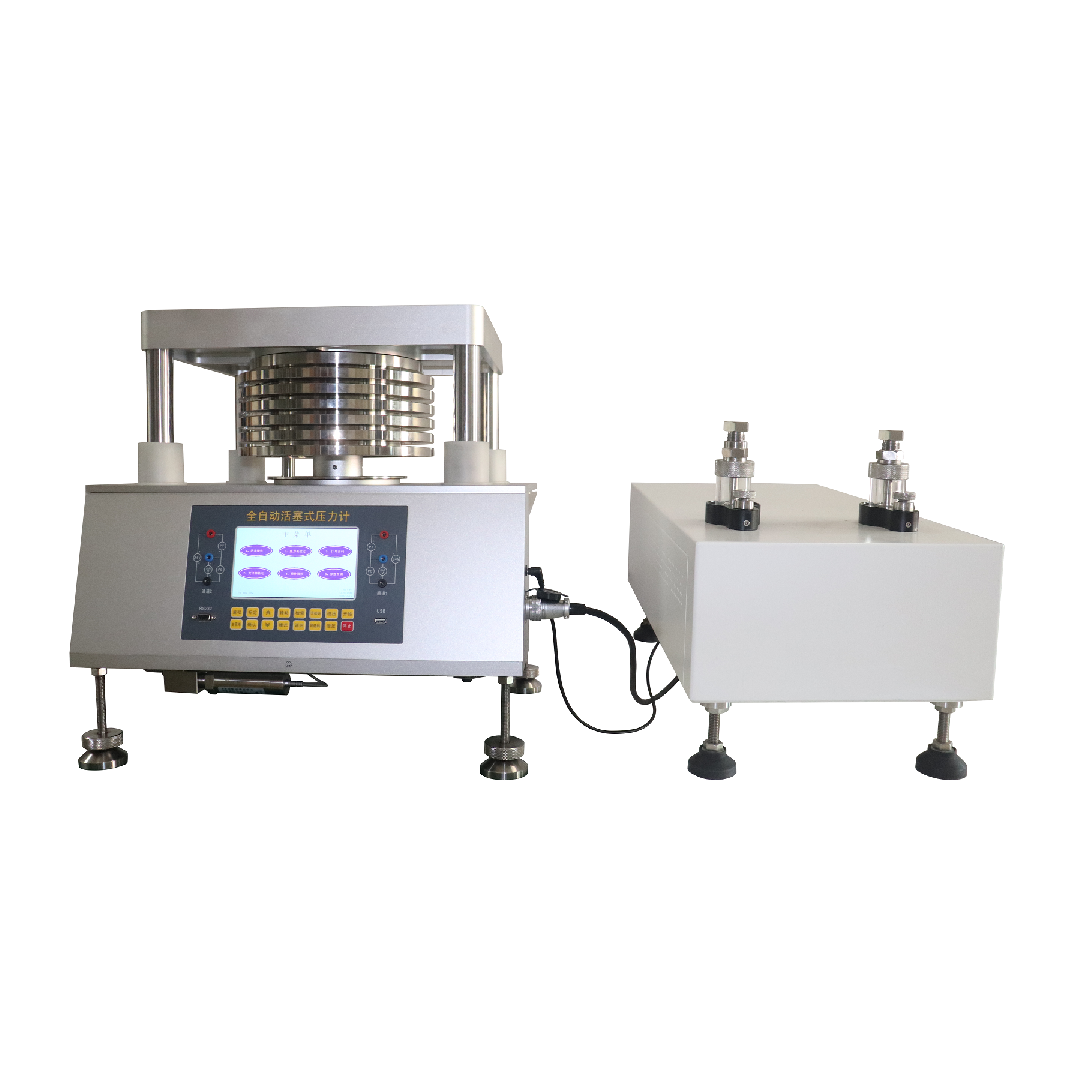

Zero-start fully automatic digital piston pressure gauge
Product Description
APSL801The micro-pressure fully automatic piston-type pressure gauge with zero start is a patented product developed by our company based on the invention patent "An Anti-Wear Fully Automatic Piston Pressure Gauge (Patent No.:ZL201910276297.7)". It consists of a fully automatic piston-type pressure gauge host, a pressure controller, and a balance.
It can achieve fully automatic weight loading, fully automatic pressurization, fully automatic balancing, and uses a balance to automatically balance the hanging basket mass, achieving zero start, and can set any decimal point fixed value. During the verification process, anti-wear can be achieved at any time, ensuring that the maximum error of the piston system within one verification cycle does not exceed the allowable error.
The system includes the functions of a fully automatic pressure calibration bench: it can fully automatically verify pressure transmitters, digital pressure gauges, precision pressure gauges, etc., send24V power, measure real-time pressure, input current, input voltage, piston position, weight rotation speed, piston head temperature, etc.
, and automatically set the number of verification points.
Specifications
- Measurement range
- (-10~60) / (-10~40) / (-10~25) kPa
- Accuracy
- Pressure: Class 0.01 / 0.02 / 0.05; Current & Voltage: Class 0.01
- Nominal piston area
- 10 cm²
- Working medium
- Air
- Pressure ports
- 2–4 × M20×1.5 quick connectors
- Weight & dimensions
- 50 kg; 436 × 464 × 630 mm (W × D × H)
Product Details
1. Overview
APSL801The micro-pressure fully automatic piston pressure gauge with zero start is a patented product developed by our company based on the invention patent "An Anti-Wear Fully Automatic Piston Pressure Gauge (Patent No.:ZL201910276297.7)". It consists of a fully automatic piston pressure gauge host, a pressure controller, and a balance. It can achieve fully automatic weight loading, fully automatic pressurization, fully automatic balancing, and uses a balance to automatically balance the hanging basket mass, achieving zero start, and can set any decimal point fixed value. During the verification process, anti-wear can be achieved at any time, ensuring that the maximum error of the piston system within one verification cycle does not exceed the allowable error. The system includes the functions of a fully automatic pressure calibration station: it can fully automatically calibrate pressure transmitters, digital pressure gauges, precision pressure gauges, etc., send24V power supply, measure real-time pressure, input current, input voltage, piston position, weight rotation speed, piston head temperature, etc., and automatically set the number of verification points.
Related patents:201810567408.5,201820858929.1,201920462275.5,201910276297.7,202122144084.4。
Can calibrate1kPa、500Pa small range micro pressure sensors, etc.
2. Technical specifications
2.1, measuring range
(-10~60)kPa;
(-10~40)kPa;
(-10~25)kPa;
2.2, accuracy
Pressure: 0.01、0.02、0.05 level.
Current:(0~22)mA,0.01class.
Voltage:(0~5.5)V,0.01class.
Nominal piston area: 10cm2。
2.3, Others
24V Power output function.
Weight material: aluminum alloy.
Piston rod material: ceramic. Piston cylinder material: ceramic.
Working medium: air.
Pressure ports: 2-4 piecesM20X1.5Quick coupling.
With 2-4 power measurement channels, convenient for calibrating pressure transmitters.
Weight:50kg. Chassis dimensions: 436*464*630*(width*depth*height).
Can connect to TMMS-2000 software to automatically print calibration reports.
Can set any pressure setpoint.
3. Weight and balance configuration
Measurement range | (-10~60)kPa | (-10~40)kPa | (-10~25)kPa |
Pressure resolution | 0.1Pa | 0.1Pa | 0.1Pa |
Weight configuration | 510g 11 pieces | 510g 7 pieces | 510g 4 pieces |
Tray mass | 360 grams | 360 grams | 360 grams |
Balance range | 3kg | 3kg | 3kg |
Balance resolution | 0.01grams | 0.01grams | 0.01g |